Guide
What is permaculture?
July 3, 2026 · 7 min read
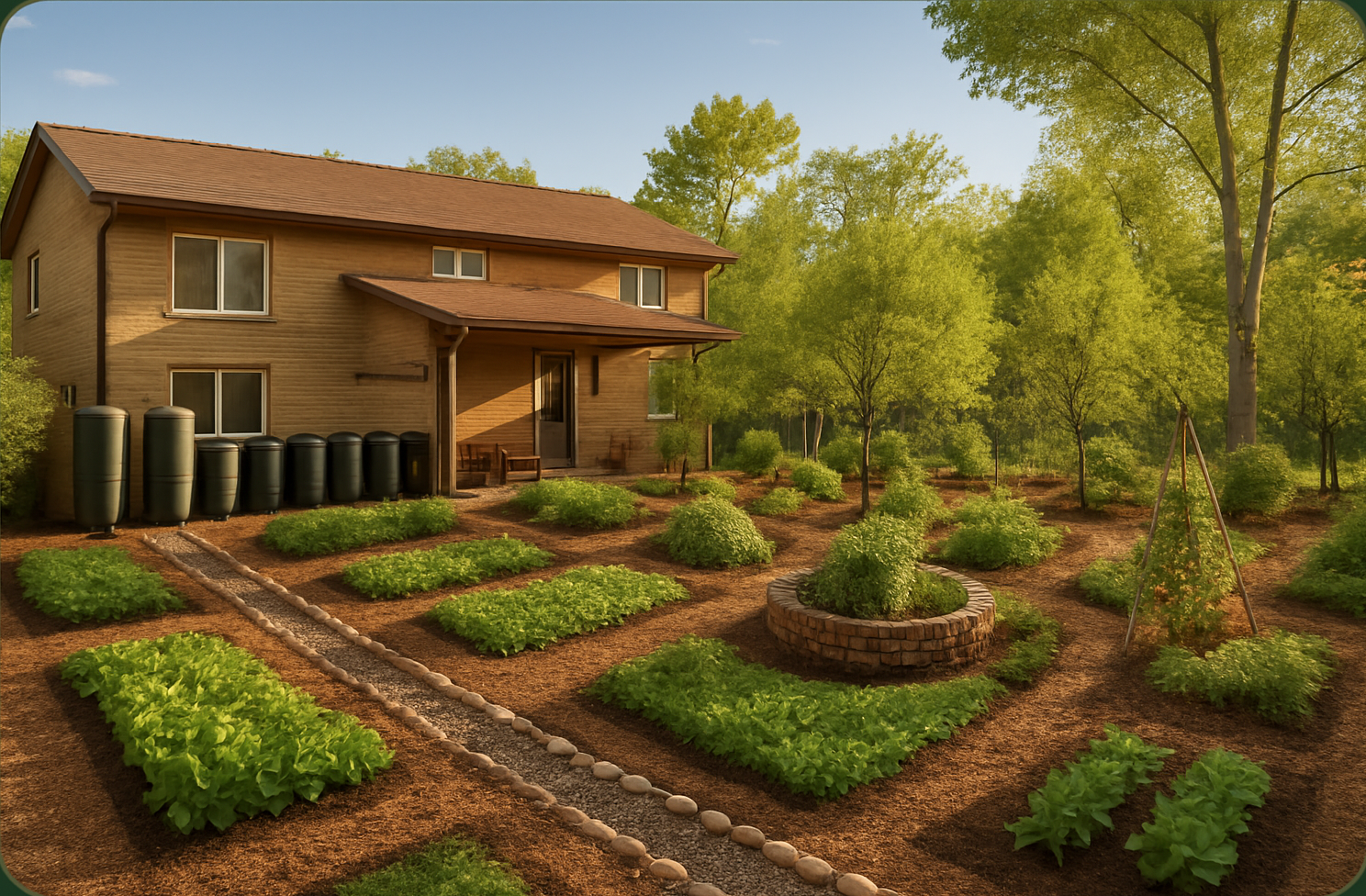
Permaculture is a design system for creating productive, largely self-sustaining landscapes by copying the patterns and relationships found in natural ecosystems. The name is a blend of "permanent" and "agriculture" — later broadened to "permanent culture" — and that is the goal: land that keeps producing food, water, and abundance year after year without being drained, tilled, or propped up by constant outside inputs. It is not a single gardening technique but a whole way of designing, and it can be applied to a backyard, a farm, or an entire property. This guide explains what permaculture is, where it came from, the ethics and principles that guide it, the techniques it uses, and how to start applying it to your own land.
Permaculture, defined
At its core, permaculture is thoughtful design that works with nature instead of against it. A natural forest or meadow builds its own soil, captures its own water, feeds a huge diversity of life, and recovers from disturbance — all with no one tending it. Permaculture asks a simple question: what if we designed the places we live and grow food to do the same? Rather than fighting a site's conditions with heavy irrigation, tilling, and chemicals, a permaculture design reads the land's existing patterns — sun, water, wind, slope, and soil — and arranges plants, water, animals, and structures so they cooperate and sustain themselves.
The word was coined in the 1970s by Australians Bill Mollison and David Holmgren, who set out to counter the destructiveness of industrial agriculture with a positive, design-based alternative. What began as "permanent agriculture" grew into a global movement covering food production, water, buildings, energy, and community — but the foundation is always the same: observe how nature already solves a problem on your site, then design to amplify it.
The three ethics of permaculture
Every permaculture design rests on three ethics, and they are what separate it from landscaping that simply looks good:
- Care for the earth — regenerate soil, water, and biodiversity rather than deplete them. The land should be healthier because of your design, not poorer.
- Care for people — meet real human needs: food, water, shelter, health, and meaningful work, designed to be accessible and resilient.
- Fair share (return of surplus) — take only what you need and reinvest the surplus — seeds, food, knowledge, soil fertility — back into the land and community instead of hoarding it.
Hold these three together and you have the test every permaculture decision must pass: does it care for the earth, care for people, and return the surplus?
The 12 principles
If the ethics are the "why," the principles are the "how." David Holmgren articulated twelve design principles — observe and interact, catch and store energy, obtain a yield, apply self-regulation and accept feedback, use and value renewable resources, produce no waste, design from patterns to details, integrate rather than segregate, use small and slow solutions, use and value diversity, use edges and value the marginal, and creatively use and respond to change. Each one is a lens for making a specific design choice. We break all twelve down with practical, homeowner-scale examples in our guide to the twelve design principles — the essential next read once the ethics make sense.
How permaculture works: zones, sectors, and guilds
Beyond the principles, permaculture uses a handful of practical planning tools that turn philosophy into a real layout:
Zones. A site is organized into zones by how often you visit and tend each area — from Zone 1 (the intensively used kitchen garden right by the door) out to Zone 5 (wild land you mostly leave alone). Placing elements by how much attention they need means less wasted walking and less wasted effort.
Sectors. Sectors map the wild energies that move through a site from outside — where the summer and winter sun track, where cold wind or fire risk comes from, how water flows across the land. Good design channels the helpful energies in and buffers the harmful ones.
Guilds and relationships. Instead of planting things in isolation, permaculture groups them into plant guilds — small communities where each member does a job for the others: a nitrogen-fixer feeds a fruit tree, a deep-rooted plant mines minerals, flowers pull in pollinators, and groundcovers protect the soil. This is the heart of the system — every element placed to support several others, so the whole needs less work than the sum of its parts. It is closely related to companion planting, scaled up from the vegetable bed to the entire property.
Common permaculture techniques
Permaculture is a design framework, so it draws on many hands-on techniques. The ones you will meet again and again include:
- Water harvesting earthworks — swales, basins, and berms shaped on contour to slow, spread, and sink rainfall into the soil, often paired with rainwater harvesting from roofs.
- Building living soil — feeding the soil food web with compost, mulch, and no-dig methods instead of tilling and synthetic fertilizer.
- Food forests — stacking perennial trees, shrubs, herbs, and groundcovers into a layered edible ecosystem; see what a food forest is for the full breakdown.
- Perennial polycultures and guilds — diverse, long-lived plantings that replace the yearly replant-from-bare-soil cycle of annual gardens.
- Integrating animals and structures — chickens, ponds, greenhouses, and catchment placed so each one's output becomes another element's input.
None of these is "permaculture" on its own — permaculture is the design thinking that decides which techniques a particular site needs and how to connect them.
Permaculture vs. related approaches
Permaculture overlaps with several other movements, and the differences are worth knowing. Regenerative agriculture shares permaculture's goal of healing land while producing food, but usually operates at farm and field scale with an emphasis on soil carbon and grazing. Agroforestry — integrating trees with crops or livestock — is one powerful technique that permaculture designs frequently use, but permaculture is the broader whole-site framework around it. Organic gardening is a practice permaculture almost always adopts, but permaculture plans the entire system, not just the inputs. The simplest way to see it: permaculture is the design layer that decides how all these good practices fit together on a specific piece of land.
Permaculture at any scale
One of permaculture's greatest strengths is that it is fractal — the same design logic works whether you have a balcony or a hundred acres. On a small urban lot it might mean a tightly stacked kitchen garden, a couple of dwarf fruit trees in guilds, a rain barrel, and a compost system. On a suburban property it becomes a layered edible landscape with earthworks and a food forest. On rural land it grows into a full homestead system with water storage, pasture, and buildings woven into the plan. The footprint changes; the ethics, principles, and design tools do not. You do not need a farm to practice permaculture — you need a design that fits the land you already have. Our beginner's walkthrough is the gentlest place to start, and our collection of real permaculture examples shows the ideas working across very different sites.
Conventional design vs. permaculture
| Conventional landscape | Permaculture design | |
|---|---|---|
| Goal | Appearance, or a single crop | Multiple yields + a regenerating system |
| Inputs | Ongoing water, fertilizer, chemicals | Falling inputs as the system matures |
| Water | Irrigated against the climate | Captured, stored, and sunk into the soil |
| Soil | Depleted by tilling & chemicals | Built by biology, mulch, and perennials |
| Elements | Placed in isolation | Placed in supportive relationships |
| Over time | Costs rise, land degrades | Costs fall, land improves |
How to start with permaculture
Applying permaculture comes down to a sequence: observe your site through a full season, start small with soil and water, plant in guilds rather than isolation, and expand zone by zone as each piece establishes. The single biggest factor in whether a permaculture project thrives or stalls is how well the design fits your specific climate, water, and soil — which is precisely what a generic plant list off the internet cannot judge.
That is the work we do. Our whole-property regenerative design service reads your land and delivers a custom, to-scale plan — done-for-you across Colorado, or as a complete design-and-build-guide package anywhere in the country. Whether you begin with a single guild or a full property, the promise of permaculture is the same: design a living system once, and let it feed you for decades.
Frequently asked questions
What is permaculture in simple terms?
Permaculture is a design system for building landscapes, gardens, and even whole properties that work like natural ecosystems — producing food and other useful yields while largely taking care of themselves. The word combines 'permanent' and 'agriculture' (and 'culture'). In practice it means observing how a site's sun, water, wind, and soil behave, then arranging plants, water, and structures so they support one another and need fewer outside inputs every year.
What are the three ethics of permaculture?
Care for the earth, care for people, and fair share (returning surplus back into the system rather than hoarding it). Every permaculture design decision is meant to serve all three at once — regenerating the land, meeting real human needs, and reinvesting the abundance the system creates.
Who invented permaculture?
Permaculture was developed in the 1970s in Australia by Bill Mollison and his student David Holmgren, who coined the term. Mollison's 'Permaculture: A Designers' Manual' and Holmgren's later work laid out the ethics and principles that practitioners around the world still use today.
Is permaculture the same as organic gardening?
No — organic gardening is a set of practices (no synthetic chemicals) applied mostly to annual vegetable growing, while permaculture is a whole design system for arranging an entire site. A permaculture design will usually be organic, but it goes much further: it plans water, perennials, soil building, microclimates, and the relationships between elements so the whole property functions as one resilient system.
Can permaculture work on a small property?
Yes. Permaculture is a design pattern, not a size. The same principles that shape a rural homestead apply to a suburban backyard, a small urban lot, or even a balcony — the elements are simply scaled and stacked more tightly. Many of the most productive permaculture sites in the world are under a quarter of an acre.
How do I get started with permaculture?
Start by observing your site through a full season — where water flows, where the sun falls, which areas you pass every day. Begin small with soil and water: build living soil, capture rainfall, and plant a single guild around one tree. From there, expand outward zone by zone. Many people accelerate the process with a professional design that maps the whole property before the first plant goes in.
Related guides
The 12 permaculture principles
David Holmgren's 12 design principles and the 3 ethics behind them, each explained with a concrete example a homeowner can actually use.
Permaculture for beginners
What permaculture actually is, its core ethics and principles, and a simple, beginner-friendly path to start designing a regenerative landscape.
What is a food forest?
A self-sustaining edible ecosystem modeled on a young woodland — the seven layers, how it works, and how to start one on any land.
Want this designed into your land?
We design regenerative food forests — living soil, water, and plants working together — done-for-you in Colorado and guided nationwide.
Book your Eden Yard Audit™