Food forest design is the craft of arranging fruit and nut trees, berry shrubs, perennial vegetables, herbs, groundcovers, roots, and vines into a single, self-sustaining ecosystem — a young edible woodland where every plant is chosen to feed people, pollinators, or the soil. Done well, it turns an ordinary yard into a landscape that produces more food and needs less work every year as it matures. This guide walks through how a food forest is designed, layer by layer — and how Restore Eden designs one for your specific site.
Why a food forest instead of a garden or a lawn
A conventional garden is an annual treadmill: till, plant, water, weed, harvest, repeat — every season, from bare soil. A lawn is worse: it drinks water and gives nothing back. A food forest flips that equation. Because it is built mostly from perennials arranged in cooperating layers, it gets more productive and less demanding over time. The trees build shade and microclimate; the groundcovers hold moisture and suppress weeds; the soil life feeds the roots. You are not fighting nature every spring — you are steering a living system that largely runs itself.
The seven layers of a food forest
The heart of food forest design is stacking — growing in vertical layers so the same square foot of ground yields food from the canopy all the way down to the roots. A complete design weaves together seven layers:
On a small urban lot, these same seven layers are simply stacked more tightly — dwarf rootstocks, vertical trellising, and intensive guild planting let a backyard hold a surprising amount of the same structure as an acre. A food forest is a pattern, not a size.
Designing for living soil
Healthy soil is the foundation of every productive food forest — and it is where most edible landscapes quietly fail. We don't just plant trees; we rebuild the living system beneath them. Drawing on soil-food-web science, our designs specify the compost, mulch, fungal inoculation, and cover-cropping needed to bring a soil's biology to life so it can feed your plants on its own. A teaspoon of healthy soil holds billions of organisms; when that food web is intact, it cycles nutrients to the roots far more efficiently than any bag of fertilizer — and it keeps doing it, for free, year after year.
Designing for water
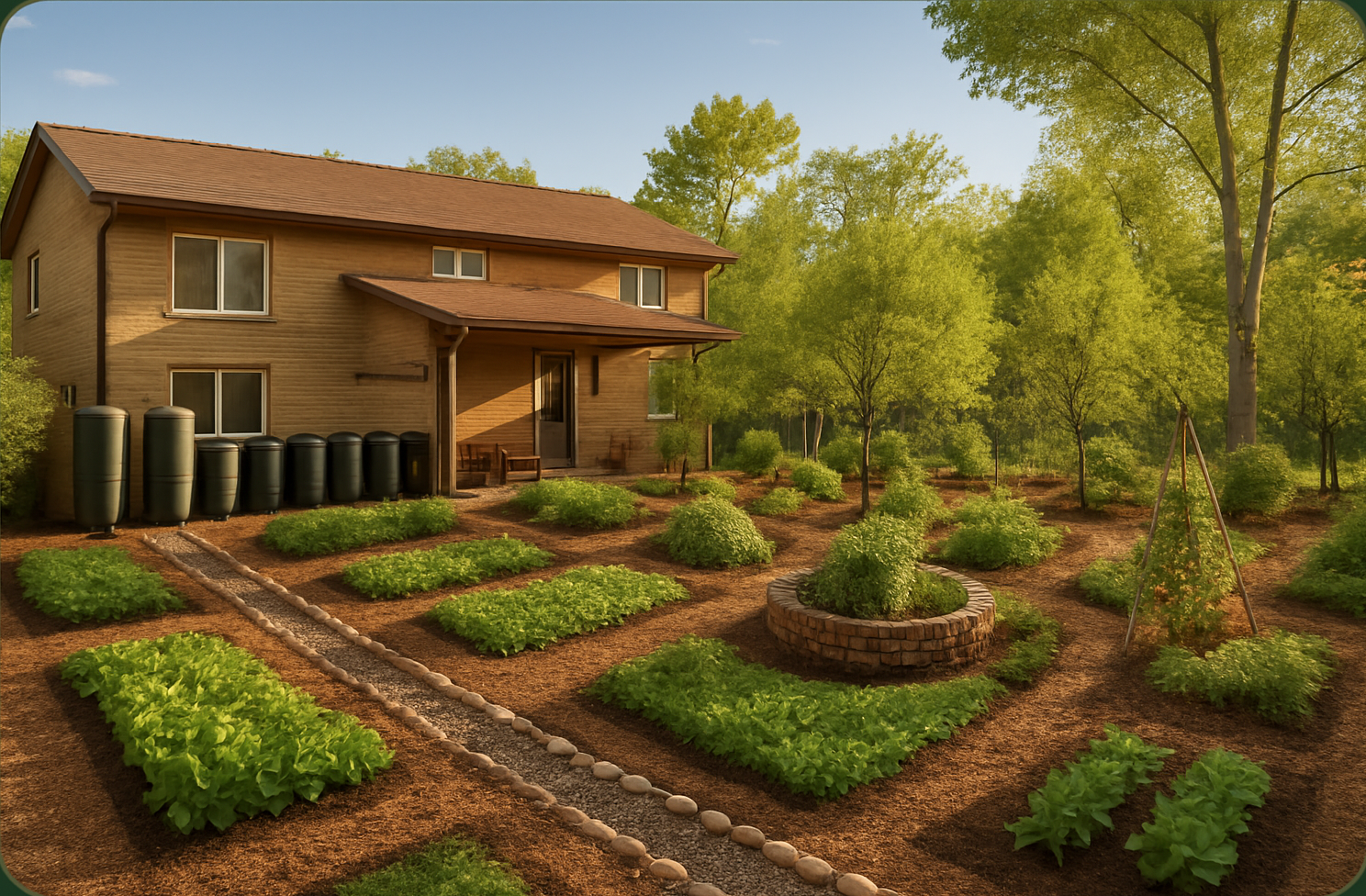
Across the arid West especially, water is the difference between a thriving food forest and a struggling one. Rather than irrigate against the climate, we design with it: swales and basins that slow and sink rainfall into the ground, rainwater catchment off existing roofs, and heavy mulch and shade that hold moisture in the soil. The result is a system that hydrates itself from the rain that already falls on your property and leans far less on the tap as it matures.
Plant guilds & companion planting
In a food forest, plants are never placed alone — they are grouped into guilds: small communities that support one another. A classic fruit-tree guild surrounds the tree with nitrogen-fixers that feed it, dynamic accumulators that mine deep nutrients, pollinator and pest-confusing flowers, and groundcovers that protect the soil. Designing these relationships — not just choosing pretty plants — is what makes the system resilient and low-maintenance. It is the difference between landscaping and regenerative design.
From urban backyards to rural homesteads
We design food forests for any land. A city lot becomes a layered edible courtyard; a suburban backyard becomes a productive orchard-garden; open rural acreage becomes a full homestead food system with water harvesting, structures, and animals integrated into the plan. The principles are the same at every scale — only the palette and the footprint change.
Designing for your climate, soil, and site
There is no universal food forest. A design that thrives on the Colorado Front Range — cold-hardy apples and cherries, drought-tolerant shrubs, deep mulch and swales to hold every drop of snowmelt — looks nothing like one for the humid Southeast or the coastal Northwest. Good food forest design starts with the realities of your site: your USDA hardiness zone and first/last frost dates, your annual rainfall, the path of the sun across the property, the slope and where water naturally flows, and what your soil is actually made of and how alive it is.
We read all of that first, then choose species and a layout that fit. Cold climates lean on hardy fruit, nut, and berry species and on microclimates — south-facing walls, thermal mass, and windbreaks — that buy a few extra degrees and weeks of season. Arid sites lead with water-harvesting earthworks and drought-tolerant perennials. Small urban lots lean on dwarf rootstocks and vertical layers. Matching the design to the site is the single biggest factor in whether a food forest struggles or flourishes — and it is exactly what a generic plant list off the internet cannot do for you.
A food forest, year by year
A food forest is planted as a young system and grown into maturity, so it helps to know what to expect. The arc is consistent even though the species and timeline vary by site:
- Year 1 — establishment. Earthworks and soil prep go in, trees and shrubs are planted small, and the herb and groundcover layers fill in fast. This is the most hands-on year: watering, mulching, and weeding while everything roots in. You already harvest herbs, greens, and perennial vegetables.
- Years 2–3 — filling in. Berry shrubs come into production, the groundcover knits together and suppresses most weeds, and the soil food web takes hold. Maintenance drops noticeably as the system starts to manage its own fertility and moisture.
- Years 3–7 — fruiting. The understory and then the canopy fruit trees begin bearing in earnest. The microclimate the trees create makes the whole system more resilient, and total yield climbs each season.
- Year 7 and beyond — abundance. A mature food forest is a largely self-sustaining ecosystem that produces a deep, diverse harvest with a fraction of the work a conventional garden of the same size would demand — and it keeps giving for generations.
Food forest vs. conventional landscaping
| Conventional landscape | Restore Eden food forest | |
|---|---|---|
| Output | Looks only — no harvest | Food, year after year |
| Over time | Degrades; needs constant inputs | Improves; needs less work |
| Water | High, ongoing irrigation | Harvests rain; self-hydrating as it matures |
| Soil | Depleted by chemicals & tilling | Living soil rebuilt by design |
| Maintenance | Mowing, spraying, replanting | Establishment, then mostly self-managing |
| Value | A cost center | A productive, regenerative asset |
How we design your food forest
Every Restore Eden design follows the same proven path — from first look to a thriving, producing system.
Eden Yard Audit™
We study your land, climate, water, sun, and soil — on-site in Colorado or remotely anywhere in the country — and map exactly what your yard could become.
Regenerative design
A custom, to-scale master plan: water strategy, soil regeneration, structure placement, and a full layered planting plan built for your site and goals.
Blueprints & build guides
Plans, planting schedules, and step-by-step installation guides — so the system gets built right, by our crew or yours.
A living, producing system
Installed for you in Colorado, or guided for your team nationwide — then your food forest matures, feeds your family, and gives back for decades.
See the full approach and real before/after transformations on the regenerative property design overview.