Permaculture design services plan an entire property as a single, self-sustaining system — water, soil, plants, structures, and the way you move through the space, all arranged to work together the way a natural ecosystem does. Instead of designing one garden bed or handing you a plant list, a permaculture designer maps how water and energy move across your land and places every element so it supports the others. The result is a property that feeds you, manages its own water and fertility, and needs less work every year as it matures. This page explains what a permaculture design includes, how the process works, and how Restore Eden designs one for your specific site.
What permaculture design actually is
Permaculture — permanent agriculture — is a design discipline for building human landscapes that function like natural ones: closed loops, no waste, and fertility that builds on itself. A permaculture design applies a consistent set of principles to your particular piece of ground. It observes before it acts, catches and stores the water and energy already falling on the site, stacks functions so every element earns its place, and starts small where you spend the most time. Done well, it is the opposite of a high-input landscape: it gets more productive and less demanding over the years rather than the other way around.
What a permaculture design includes
A professional permaculture design is a complete, buildable master plan — not a sketch and a wish list. Every Restore Eden design brings together six core deliverables:
Zones & sectors: the heart of the method
What separates a real permaculture design from ordinary landscaping is how things are placed. Two tools drive every decision. Zones organize the property by how often you use each area — the herbs you cut daily sit by the door; the semi-wild foraging and timber sit at the edges — so effort follows attention and nothing productive gets stranded where you never walk. Sectors map the energies that cross your land from outside: where the summer and winter sun track, which way the hard winds come from, how water flows across the site, where wildfire or noise or frost pool. The design then places each element to harvest the good energies and deflect the harmful ones — a windbreak on the cold side, a sun-trap on the warm one, water-harvesting earthworks on the contour where the water already wants to go.
Water, soil, and structures — planned as one
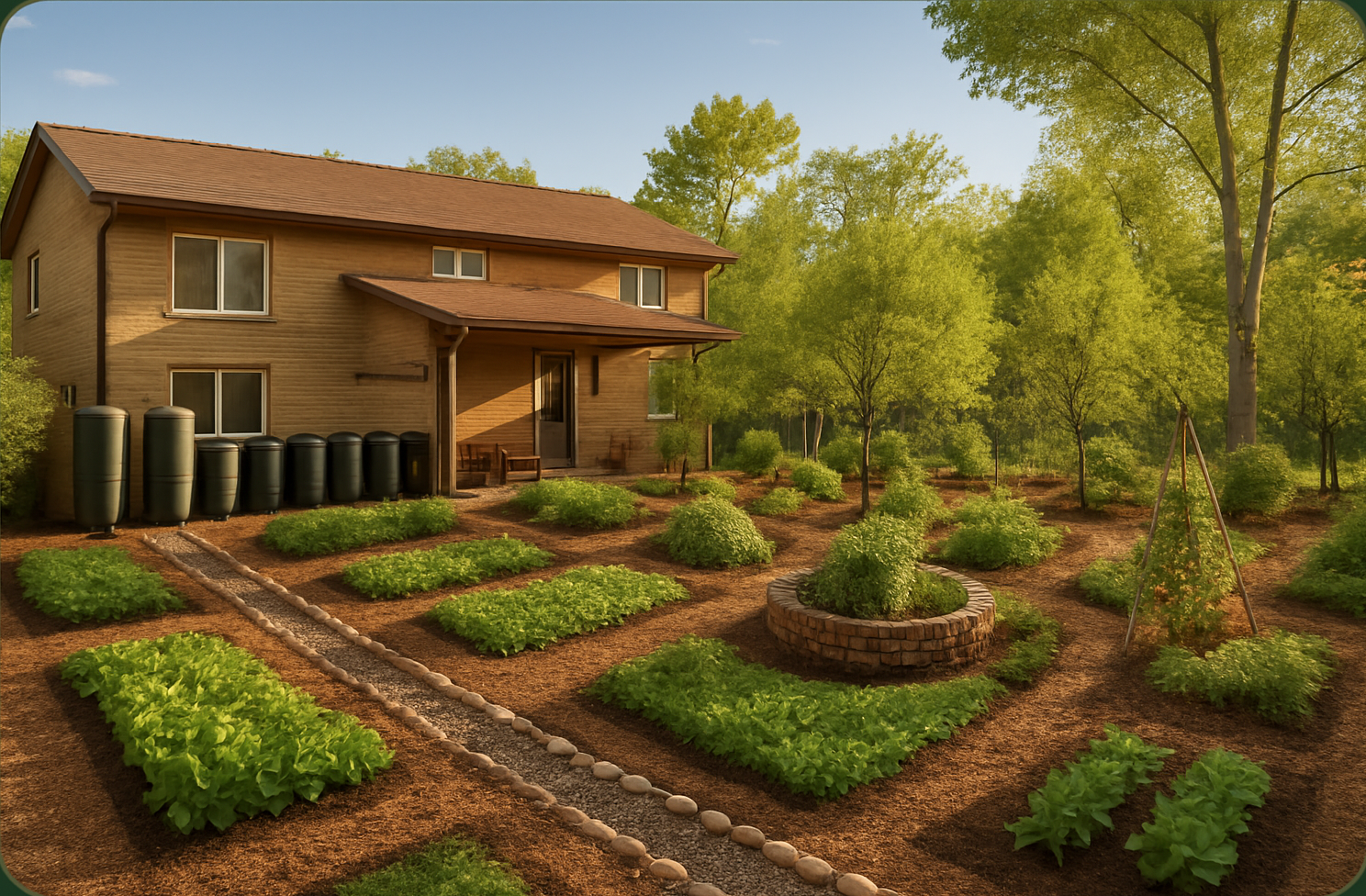
In a permaculture design nothing is solved in isolation. Water comes first, because it shapes everything downstream: we read the slope and design rainwater harvesting and earthworks — swales, basins, and catchment — to slow, spread, and sink every drop into living soil rather than letting it run off. Then soil regeneration turns that hydrated ground into a living food web that feeds plants for free. Structures — home, greenhouse, sheds, animal systems — are placed to shed water where it's wanted and to shelter the zones that need it. Only then does the layered planting plan go in, so the food system sits on top of water and soil that already support it. That sequence — water, access, structures, soil, then plants — is what makes the finished property resilient instead of thirsty.
Permaculture design vs. conventional landscape design
Both start with a plan and a crew. The difference is what the plan is for. A landscape design optimizes for how a space looks on install day. A permaculture design optimizes for how a property performs over decades — what it produces, how much water and fertility it needs from you, and whether it improves or degrades with time.
| Conventional landscape design | Restore Eden permaculture design | |
|---|---|---|
| Goal | How it looks on install day | How it performs for decades |
| Water | Irrigation piped in against the climate | Rain harvested and stored on-site |
| Soil | Amended once, then depletes | A living food web rebuilt by design |
| Plants | Chosen for appearance | Chosen to feed you, pollinators & the soil |
| Over time | Costs more to maintain each year | Needs less work as it matures |
| The result | An ongoing expense | A productive, regenerative asset |
From urban lots to rural homesteads
The same method scales to any land. On a city lot, a permaculture design becomes a layered edible courtyard with rain gardens and vertical growing. On a suburban property it becomes a productive orchard-garden with water harvesting off the roof. On open rural acreage it becomes a full homestead system — water, soil, food forest, gardens, structures, and animals woven into one plan. The principles hold at every scale; only the palette and the footprint change. We design for whatever you have, from a quarter-acre in town to a working homestead.
Working with a permaculture designer
You don't need to become a permaculture expert to have a property designed like one. Working with an experienced permaculture consultant means the years of pattern-reading — how water behaves on a slope, which species thrive together in your climate, what to build first — are already done for you. We translate your goals (more food, lower water bills, a beautiful and productive yard, a resilient homestead) into a concrete, staged plan, and we stay available as you build so the design adapts to what the land tells you. Whether you want a full done-for-you installation or a complete plan to build yourself, the design is the foundation everything else stands on.
How our permaculture design process works
Every Restore Eden design follows the same proven path — from first look to a thriving, producing system.
Eden Yard Audit™
We study your land, climate, water, sun, and soil — on-site in Colorado or remotely anywhere in the country — and map what your property could become.
Whole-property design
A custom, to-scale master plan: water strategy, soil regeneration, structure placement, zones and sectors, and a full layered planting plan built for your goals.
Blueprints & build guides
Plans, planting schedules, and step-by-step installation guides — so the system gets built right, in the right order, by our crew or yours.
A living, producing system
Installed for you in Colorado, or guided for your team nationwide — then your land matures into a self-sustaining, food-producing ecosystem.
New to the practice? Start with a plain-English explainer of the whole approach or the beginner's guide to regenerative design, or see real transformations on the projects overview.