Guide
How to grow your own food
July 3, 2026 · 8 min read
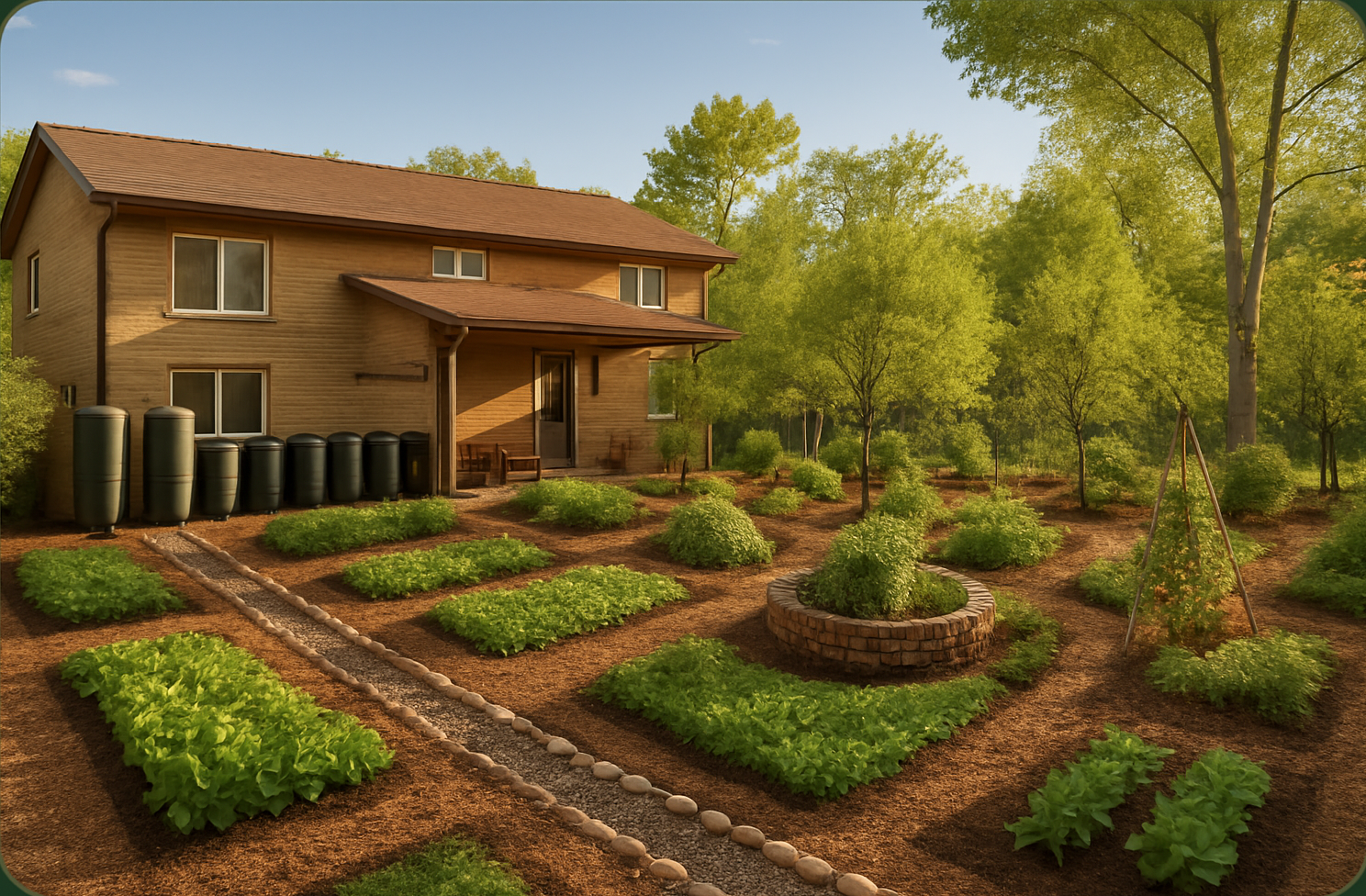
The most durable way to grow your own food is to stop thinking of it as a garden you tend every day and start thinking of it as an ecosystem you design once and harvest from for decades. You start small with a few high-return crops, learn the rhythm of your land, and then build toward a layered, largely self-maintaining system that produces more with less work every year.
This guide is for the homeowner who looks at the industrial food system and sees fragility. You want your land to actually feed your family, to give you control, and to leave something real for your kids. Not a hobby. Provision.
Why grow your own food right now
The reasons to grow food have shifted from nostalgia to strategy.
The modern food supply is long, complex, and brittle. Most of what fills a grocery shelf traveled thousands of miles through a handful of chokepoints. When any link strains, prices jump and shelves empty. You felt it in the last few years, and the pattern is not going away.
Cost is the second driver. Grocery inflation compounds, and the crops that are most expensive at the store, berries, fresh herbs, salad greens, are often the easiest to grow at home. Water and land costs keep climbing too, which makes a productive yard an appreciating asset rather than a decoration.
Then there is control. When you grow your own food you decide what touches it. No mystery sprays, no ambiguous origins, no recall notices. You know exactly what your family eats because you grew it.
Finally, there is legacy. A yard planted with fruit trees and perennial food is a gift that outlives you. Your kids learn where food comes from by pulling it out of the ground with their own hands. That is a kind of wealth the market cannot inflate away.
Start small, then scale
The single biggest mistake new growers make is starting too big. They till a huge plot, plant everything at once, get overwhelmed by weeds and watering in July, and quit by August with a yard full of regret.
Do the opposite. Start with one bed you can actually manage, roughly four feet by eight feet, and get a win. That win, real food you grew, is the fuel for everything that follows.
Here is the sane sequence:
- Observe first. Watch your yard for a few weeks. Where does the sun fall for six or more hours? Where does water pool after rain? Where does the wind hit hardest? Your best growing spots reveal themselves.
- Build one good bed. Raised or in-ground, filled with quality soil and compost. Soil is the whole game. Feed the soil and it feeds the plants.
- Plant a handful of proven winners (more on those below).
- Add water and mulch. A simple drip line and a thick mulch layer cut your labor and water use dramatically.
- Expand only after a full season. Once one bed feels easy, add the next. Growth should follow competence, not enthusiasm.
This slow-scale approach is the difference between people who garden for one summer and people who feed their families for life.
The highest-return crops for a beginner
Not all crops reward you equally. For your first season, plant the ones that are hard to fail with and generous in return.
- Leafy greens (lettuce, kale, chard, spinach): fast, forgiving, and cut-and-come-again for weeks.
- Cherry and grape tomatoes: enormous yield from a couple of plants, and store-bought ones are expensive.
- Zucchini and summer squash: almost aggressively productive; two plants can overwhelm a family.
- Bush beans: reliable, nitrogen-fixing, and prolific.
- Herbs (basil, mint, oregano, thyme, parsley): tiny footprint, high grocery value, and many are perennial.
- Radishes: ready in a month, perfect for keeping kids and beginners motivated.
Master a few of these and you have proven you can grow food. That confidence is what carries you to the next, more powerful stage.
The leap: from annual beds to a perennial food system
Here is the insight that separates a hobby garden from real food security.
An annual vegetable garden is a treadmill. Every spring you start over. You till, buy seeds and starts, plant, water constantly, weed, fight pests, harvest, and then watch it all die in fall so you can do it again next year. The yield is real, but so is the labor, and it never decreases.
A perennial food system works the opposite way. You plant fruit trees, berry bushes, and perennial vegetables once, and they come back stronger every single year with less work. Instead of a flat plot growing one layer of crops, you stack the yard vertically the way a forest does, tall fruit and nut trees, smaller fruit trees beneath them, berry shrubs, herbs and perennial vegetables at ground level, and roots below. This is a layered edible ecosystem, and it produces far more food per square foot than a row garden while asking for less and less of you over time.
This is the heart of the Restore Eden approach. The most resilient way to grow a lot of food with little ongoing labor is to design the entire yard as a layered, perennial food-producing ecosystem, not a set of beds you babysit. The trees anchor the system, the shrubs fill it in, the ground covers protect the soil, and the whole thing starts to feed and maintain itself. If you want to understand how the pieces fit together, a beginner-friendly design approach is the place to start, and choosing the right fruit trees for your climate is one of the highest-leverage decisions you will make.
The best gardeners still grow annual vegetables, greens, tomatoes, squash, because they are fast and delicious. But they nest those annuals inside a perennial backbone that does the heavy lifting. You get the quick wins and the long-term abundance.
Annual garden vs. perennial food-forest system
| Factor | Annual vegetable garden | Perennial food-forest system |
|---|---|---|
| Ongoing labor | High, and constant every year | High to establish, then drops sharply |
| Yield over time | Flat; resets to zero each spring | Compounds; grows year after year |
| Water needs | High, especially in summer | Lower once roots and mulch mature |
| Resilience | Fragile; one bad stretch can wipe a season | Deep-rooted and self-buffering |
| Soil health | Degrades with repeated tilling | Improves as the system matures |
| Time to first harvest | Weeks | Months to a few years, then decades |
| Best role | Fast wins, salad crops, variety | The durable engine of food security |
The takeaway is not that annuals are bad. It is that annuals alone will keep you on the treadmill forever, while a perennial system is what actually buys you resilience and freedom.
How much land do you really need
Far less than you think.
You do not need acreage. A standard suburban yard, planted intelligently, can produce a serious amount of food, a meaningful share of a family's fruits and vegetables, and in some cases most of the fresh produce you eat. The trick is density and layers, not raw square footage.
A single semi-dwarf apple tree can produce more fruit than a family eats fresh. A short row of raspberries or a few blueberry bushes yields pounds of expensive berries every year. Vertical growing, dense planting, and the stacked layers of a food-forest design let a quarter-acre outproduce a poorly used full acre.
What you can grow in dollar terms depends on size, crops, climate, and effort, and it is unwise to promise numbers. But the real return is not just money saved at the register. It is the food on your table that no supply chain can take away, and a yard that is worth more because it feeds people.
Season and climate realities
Honesty matters here, because ignoring climate is how people get discouraged.
Your growing zone determines what thrives, when you plant, and how long your season runs. A grower in Colorado plans around a short, intense summer and hard winters. A grower in the Southeast fights humidity and pests but harvests nearly year-round. Neither is better, they just call for different plans.
The good news: every climate can grow food. Cold-climate growers extend their season with cold frames, row cover, and hoop houses, and lean on hardy crops and perennials bred for their zone. Hot-climate growers use shade and timing. Choosing plants suited to your specific place, especially the perennial trees and shrubs that will live for decades, matters far more than the length of the calendar.
This is exactly why a generic plan fails and a place-specific one succeeds. The layout that feeds a family in Denver is not the layout that feeds one in Georgia. Matching the right layers and species to your land, sun, soil, and season is what turns a hopeful yard into a productive one.
Your next step
You can start this weekend with one bed and a handful of greens. Do it. That first harvest changes how you see your land.
But if your real goal is food security, a yard that feeds your family for decades and leaves a legacy for your kids, the smartest move is to design the whole system on purpose from the start. That is what we do at Restore Eden: turn ordinary yards into layered, regenerative food forests, done-for-you in Colorado and through detailed design and build-guides nationwide.
If you want to see what your specific yard could produce, explore a custom food-forest plan or book a consultation and we will walk your land, your climate, and your goals with you. Grow food. Restore soil. Reclaim sovereignty, one yard at a time.
Frequently asked questions
How much food can I grow in a backyard?
A well-designed suburban lot can produce a serious portion of a family's fruits and vegetables, and in some cases most of the fresh produce you eat. The exact amount depends on size, crops, climate, and how much effort you invest. A perennial system that layers fruit trees, berries, and vegetables over the same ground yields far more per square foot than a single row garden.
What is the easiest food to grow for beginners?
Leafy greens like lettuce, kale, and Swiss chard are the easiest food to grow because they sprout fast, forgive mistakes, and produce for weeks. Zucchini, bush beans, cherry tomatoes, and herbs are close behind. Start with a handful of these, get a win, and expand from there.
How much land do I need to grow your own food seriously?
Less than most people think. A tenth of an acre, intensively planted, can supply a meaningful share of a family's produce, and a quarter-acre lot with fruit trees and berries can do a great deal more. Vertical growing, dense planting, and perennial layers stretch small spaces much further than a traditional garden plot.
Can I grow food if I have a short growing season?
Yes. Cold-climate growers extend the season with cold frames, row cover, and hoop houses, and lean on crops that thrive in cool weather. Choosing hardy perennials and varieties bred for your zone matters more than the calendar. Season length shapes what you plant, not whether you can grow food at all.
Is it cheaper to grow your own food than to buy it?
It can be, especially for high-value crops like berries, herbs, and salad greens that are expensive at the store. Costs are highest in year one when you build beds and buy plants, and drop sharply after that, particularly in a perennial system that returns each year on its own. Think of it as durable value and food security rather than guaranteed savings.
Related guides
Sustainable landscaping
Practical sustainable landscaping ideas and examples for a yard that gives back.
Carbon sinks, explained
What a carbon sink is, clear examples, and how your yard can become one.
Examples of permaculture
Fifteen concrete examples of permaculture in action — backyard, farm, and urban — with what makes each one work.
Want this designed into your land?
We design regenerative food forests — living soil, water, and plants working together — done-for-you in Colorado and guided nationwide.
Book your Eden Yard Audit™